In the summer of 2024, after a year of beginning to engage with questions of Israel and Palestine, JOIN for Justice convened a task force to make recommendations about JOIN’s role when issues of Israel and Palestine impact our organizing.
For many years, JOIN’s practice was to say that, since it focused on domestic organizing, it would primarily not engage with questions of Palestine and Israel and would focus on the many domestic justice topics where its constituencies largely agreed. While it might have been easier to continue to not say anything about this topic, we recognized that it was no longer a viable option. Increasingly, people we train have voiced that they were often unequipped to respond when questions of Israel and Palestine interfered with their organizing and it is our role to support their work. Beyond that, while our constituents disagree about what should happen in the Middle East, for many of them, this is a deeply personal issue. The last year has only made that more so.
Over four months, the task force did very strong work, proving that talented Jewish leaders who disagree strongly can still identify common values, work together respectfully, and find ways to stand for the whole. We believe that this process can serve as a model for other organizations. This document lays out that process.
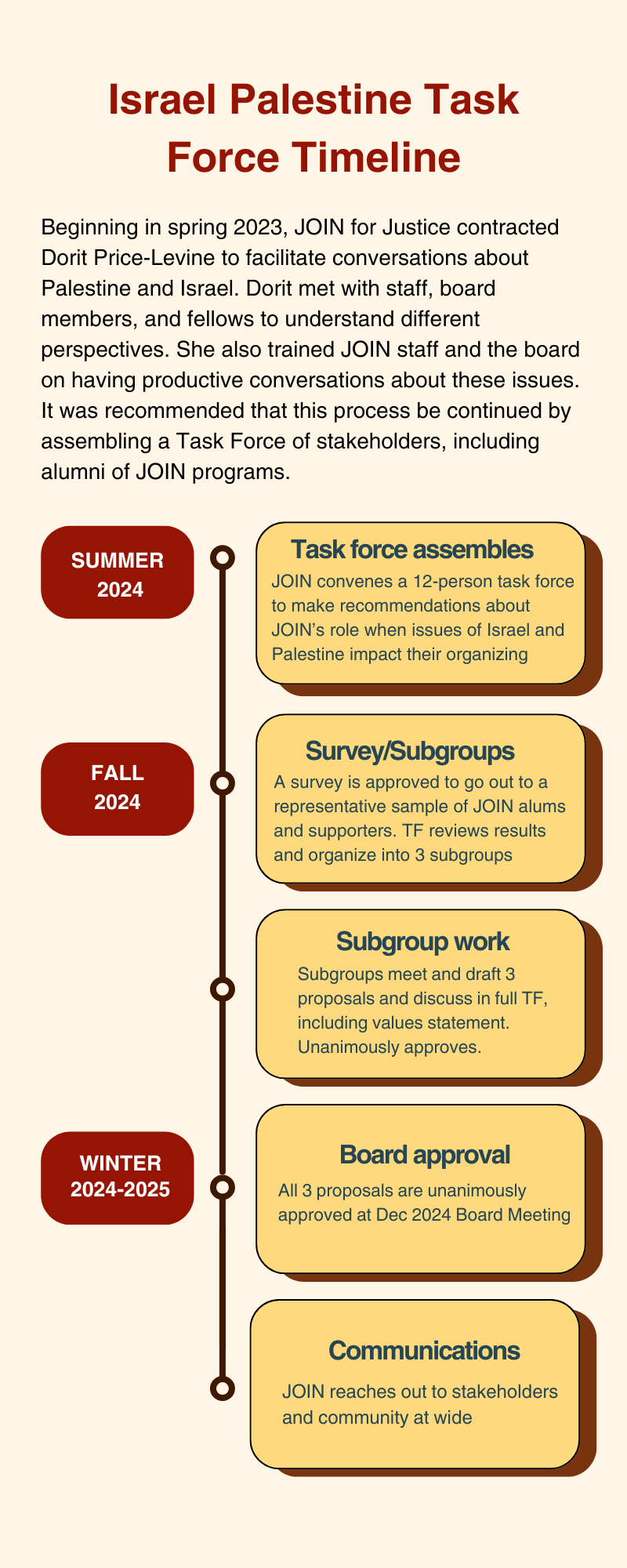
Spring 2023 – Spring 2024
JOIN contracted with Dorit Price-Levine, a skilled facilitator with a long history of working with organizations grappling with Israel and Palestine. She met with staff, board members, and fellows of the Jews of Color Organizing Fellowship to understand where different JOIN leaders were coming from. After those meetings, Dorit trained JOIN’s staff and board in how to have generative conversations about Palestine and Israel. We understood that, until we could talk to each other, we couldn’t do this work in our wider community. Dorit recommended next steps JOIN could take as an organization.
Summer 2024 – JOIN organizes a task force
JOIN recruited a 12-person task force made up of alums, board members, and staff members. Towards the project’s high level of organizational priority and accountability, both of JOIN’s executive directors and board co-chairs served on the task force. The twelve people spanned affiliation with JOIN’s different programs, identities, and personal stances on what should happen in Palestine and Israel. The task force was charged to answer three questions:
- What do we believe? Are there common values that JOIN could publicize, stand behind, and use to guide our training across our constituencies and our decisions as we navigate how Israel-Palestine impacts our work and our constituencies’ organizing.
- What should we train? We asked what new trainings we should design to support all of our programs as they faced Israel-Palestine’s impact on themselves, their values, and their organizing.
- Who do we work with? We asked if and when we would be ready to open up partnerships, primarily placements, to positions that worked directly on Israel and Palestine.
First task force meeting – August 2024
After agreeing to the goals and the order of their work, the task force members shared their own stances on Palestine and Israel and discussed how they would stand for their beliefs while working for decisions that reflect the interests of all of the diversity of JOIN. The task force approved a survey to go out to a representative sample of JOIN alums and supporters.
Second task force meeting – September 2024
The task force reviewed the results of the survey and drew out lessons. More on the survey below. They then broke into three subgroups to work on the three questions they faced.
The values subgroup met twice between the second and third meetings. They reviewed JOIN’s general values and brought suggested language, as well as examples from other organizations that had stated their values or positions in compelling ways. After that work, the subgroup crafted a list of values and explanations to be presented to the full task force.
Third task force meeting – October 2024
After the subgroup presented its work, the task force debated and amended the values statement.
Fourth task force meeting – October 2024
The task force broke into smaller groups to discuss the training that they believe they and other JOIN constituencies could benefit from when their organizing is impacted by Palestine and Israel.
The training subgroup met after the fourth session and recommended that JOIN’s staff be tasked with designing new trainings that would teach:
- How to respond and navigate situations where issues of Israel and Palestine disrupt our domestic organizing.
- How (and why) to stay in coalition during conflict over Israel and Palestine – finding strategies other than keeping quiet or attacking and leaving.
- When, outside of their work with JOIN, organizing for any position on Palestine and/or Israel, doing so in ways that reflect our values. People will be encouraged to organize consistently with these values and to challenge people who don’t, particularly if they see themselves as in the same camp.
- While we do not feel that it is JOIN’s role to teach about the particular issues of Palestine and Israel, we will explore compiling a list of resources and organizations that it would make sense for an organization like JOIN to refer people to.
JOIN will offer these trainings in its programs as well as provide them in other settings. As JOIN teaches on how to stand against antisemitism that has become much more public over the past year, it will also draw on these lessons to help people organize effectively against antisemitism, fight against antisemitism and all forms of oppression, stand with other communities against antisemitism and other forms of oppression and stay in coalition even when there is disagreement about the best policies for Palestine and Israel, and to stand against dehumanization of Jews, Palestinians, and People of Color. We believe that this isn’t only the right thing to do, but it’s what works.
After the meeting, the placements subgroup recommended maintaining JOIN’s current policy on organizations where we place fellows. JOIN has placed fellows for years in organizations that take positions on Israel and Palestine as long as their own work does not engage with it. We have a responsibility to set our fellows up for success and do not feel that we are ready at this point to insert this level of potential conflict between fellows in a way that helps them navigate it. We will observe how our implementation of the task force recommendations over the next year works out and then will be in a position to revisit this decision. We agreed that if, in the future, we do expand our potential fellowship placements, it will only be with organizations and positions that adhere to our values.
Fifth task force meeting – November 2024
The task force goes over the three proposals (values, training, and placements), made changes, and unanimously approved them. The task force recommended that, when decisions need to be made in the future about JOIN’s role, JOIN’s co-executive directors will have the authority to make the final decision and will be accountable for it.
JOIN’s board made small changes and unanimously ratified the proposals in December 2024.
Reflections on the process
We were gratified from the very beginning with people’s ability to stand for their own beliefs while treating people who disagreed with respect. When people disagreed, they were relational – they named their disagreement and then asked questions rather than trying to force the person they were talking to to change. People understood that, for the process to work, they had to both stand up for their positions and seek out decisions that stood for the whole of JOIN, including people who disagreed with them. We hoped going into this process that, in spite of great disagreement, most of the people in JOIN’s world did agree on common values, they just disagreed on how to get there. From the first session, the task force members demonstrated what was possible and showed the great talent that JOIN’s alums have.
As task force members deliberated, we found that there were values that motivated all of us – we agreed on how people should act ethically and, in general terms, what we hoped the future would look like for Jews and Palestinians, even as we disagreed on how to get there. We also recognized that when people stray from these values, people across the spectrum are impacted. For instance, Jewish tradition teaches about “machloket le’shem shamayim,” conflict in the name of heaven. One task force member pointed out that an opposite of conflict in the name of heaven is cancel culture. People agreed that when activists attempt to drive Zionists out of public life or some Jewish communities attempt to drive out Jewish anti-Zionists, both of those behaviors are not “machloket le’shem shamayim.” The task force’s work and the survey results demonstrated that, while our constituencies are very divided on these issues, there are commonalities that we can build on.
The task force process got JOIN where it needed to go, but its successful work is also a victory in its own right. We believe this process can serve as a model for other broad-based Jewish organizations struggling to find their place in the larger ecosystem. JOIN is happy to share its learning with the many other Jewish organizations grappling with similar questions. Finally, we have enormous gratitude for the members of our task force.
More on the survey
At the beginning of September, JOIN sent out a survey to 150 alums, a group designed to accurately reflect the geography of JOIN alums’ programs, roles, identities, and stances on Palestine and Israel. Seventy five people filled out the survey. People could choose to give their names or remain anonymous. Close to 40% were JOIN Organizing Fellowship/ Empower Fellowship alums, and 35% were clergy or synagogue leaders. People’s responses were thoughtful, particularly when they challenged JOIN.
Many respondents were gratified by JOIN’s initial statement last January, while some were disappointed that it didn’t offer more explicit solidarity with Israeli Jews or Palestinians. Many people appreciated it, saw themselves in it, and recognized the challenges that Jewish justice organizations face. Some of those who were disappointed were also concerned that we would stand with people who held “all stances” on Israel and Palestine, asking if there are no lines that can’t be crossed if we are to hold onto our values. A small number, on the different ends of our political spectrum, were outraged by the statement and said that they could not consider an organization that did not stand explicitly with their stance to be a justice organization. We respect all of these responses and know how imperfect that statement was; it was written in haste in response to circumstances and was made before we did the work that we have now completed.
When we asked “What roles do you think it would be strategic and impactful for JOIN to play in the broader ecosystem?”, we received these responses.
| Train leaders and organizers in how to navigate when issues involving Israel and Palestine impact organizing in the United States on domestic issues | 90.3% |
| Train leaders and organizers to respond when efforts in public life, particularly those tied to Palestine and Israel, veer into antisemitism, racism, and Islamophobia | 88.7% |
| Train leaders and organizers to stay in coalition even when it is riven by division over Israel and Palestine | 87.1% |
| Train people to make sure that Jewish organizing supports and respects the humanity of all people and stands against anything that dehumanizes any community | 86.2% |
| Train leaders and organizers on how to have respectful, generative conversations across lines of difference about Palestine and Israel | 69.2% |
| Teach leaders and organizers about issues and various perspectives relating to Israel and Palestine | 46.8% |
| Take public positions on Israel and Palestine | 12.3% |
| Directly train leaders and organizers to organize for Zionist and anti-Zionist causes | 3.1% |
In response to the question of whether JOIN should begin placing fellows in organizing positions that worked explicitly on Israel and Palestine, 11.9% said that JOIN should.
None of this surprised us – our alums are thoughtful, ethical, talented people who strongly hold a variety of political opinions. We expected that, in spite of that, people did largely hold some common values. We are gratified to find that we were correct.




 Meir Lakein (he/him)is a visionary community organizer with more than 30 years of experience mobilizing communities at the intersections of social justice and Jewish life. From 2011 to 2022, Meir was the Director of Organizing at JOIN for Justice, and during that time, he created JOIN for Justice’s Fellowship for Clergy. He has trained over one thousand rabbis to be organizers for change, and has provided hundreds of consultations to synagogues and Jewish organizations nationwide. Regarded as a mentor for a generation of young organizers and rabbis, Meir has shaped a new Jewish leadership model rooted in relationships, humility, and collective equity. Prior to coming to JOIN, Meir served as the lead organizer for the Jewish Community Relations Council of Greater Boston, organizing thousands of adults and teens in 14 synagogues to identify their common values and interests, develop a common story and mission, and take action to live their values and defend their interests — both in the community around public issues and within their own institutions. He also worked as the lead organizer of the Brockton Interfaith Community, a coalition of 25 churches and synagogues that won major victories in areas such as home ownership, prescription drugs, nursing home care and employment, and certification for immigrant nurses. Meir has experience building powerful organizations with homeless people in Connecticut and with Mizrachi, Russian, and Arab public housing tenants in Israel. His work and writing have been featured in myriad publications.
 Jeannie Appleman has trained, organized, and coached more than 1200 clergy and lay leaders from multiple faith traditions and ethnicities for 35 years, first in multi-racial & interfaith coalitions, and then with synagogues, Federations, and Jewish organizers from 4 movements. Through her vision of training rabbinical students in organizing and leadership development, she co-founded the Seminary Leadership Project in 2005 with Meir Lakein and Rabbis Stephanie Kolin and Noah Farkas and has trained more than 1000 seminary students in organizing, congregational development, and leadership. In addition to the Seminary Leadership Project, she also coordinates JOIN’s national SEA Change Initiative, which has trained and coached synagogue leaders from 6 cohorts in 3 cities, and moved them into multi-racial, interfaith coalitions, shoulder to shouder, working for change with other communities.
 Catherine is a veteran nonprofit leader, ICF Professional Certified Coach, and facilitator who has spent the last two decades supporting people to unleash their power as change-makers.
 Ali is an administrator, events coordinator, and creative professional with over ten years of experience working in non-profits, higher education, and the performing arts. Skilled in managing complex projects, Ali has successfully led initiatives that align with organizational goals, promote community engagement, and elevate the overall attendee experience through inventive programming. Ali's passion for social justice significantly influences their project and event management approach. They excel in bringing creative visions to life, ensuring seamless operations, and curating exceptional digital and live event experiences, including webinars, conferences, lectures, galas, and live performances. Ali enjoys painting, volunteering, and creative writing in their spare time. Ali holds a BA in Theatre from Penn State University and an MA in Theatre from Villanova University. They live in Philadelphia with their wife, Emily, and three cats.
 Lisa brings over 25 years’ of experience specializing in nonprofits in the Boston area. She has extensive experience with financial leadership and building effective systems for organizational success. She is a Certified Management Accountant (CMA) and her finance specialties include restricted income management and multi-year planning.
 Hara Jun (she/her/hers) brings nearly 20 years of administrative experience from diverse sectors, including academia, non-profit organizations, and healthcare. She has a strong background in operations management, office administration, and financial oversight. Most recently, she has utilized her coordination and data management skills as the Interlibrary Loan Specialist at the Klau Library in Cincinnati, Ohio. Hara also has a rich academic background, with an M.Div. in Bible from Alliance Theological Seminary and an M.Phil. in biblical and ancient Near Eastern studies from Hebrew Union College-Jewish Institute of Religion. With these degrees, she has taught at HUC-JIR, the University of Dayton, and Methodist Theological Seminary in Ohio as an adjunct professor from 2020-2024.

 Kathleen (Kat) Tedford (she/her/hers) is a storyteller, community builder, and advancement leader with over 15 years of experience mobilizing resources across domestic and global social impact landscapes. Most recently, she has driven advancement and operations for large-scale, multi-donor portfolios, and led strategic consulting initiatives that built authentic partnerships across racial and institutional divides to advance health equity. Previously, Kat worked extensively in global health, democratic governance, and civil society. Serving in leadership roles at organizations like RTI International, UNC Carolina Population Center, and Johns Hopkins, she successfully and collaboratively resourced initiatives that empowered local leaders and advanced community-level change across Africa, Asia, and the Caribbean. Kat’s success in this work can be measured by the deep, intentional collaboration she’s led or contributed to, which has resulted in improved outcomes with the community stakeholders closest to the issues requiring change.
 Jan graduated from Virginia Commonwealth University School of the Arts with a double major in Photography and Art Education. She is a seasoned educator with ten years of teaching experience, working in diverse settings locally and abroad. She has led international cultural exploration trips with experiential education companies for high schoolers in Southeast Asia. Jan is dedicated to promoting creativity, empathy, and cross-cultural understanding.


 Leili (she/her) has 11 years of experience in grassroots organizing, facilitation, and leadership development. Her experience began in Los Angeles, where she started her career organizing local and state-level campaigns in support of domestic workers’ labor rights and school funding reform campaigns. As a Bend the Arc organizer, Leili led campaigns in support of reforming solitary confinement and cash bail at the California state level. During her final years at Bend the Arc, she was the Selah Program Director where she led two cohorts dedicated to Jewish People of Color. Since March 2022, Leili has been the Director of Racial Equity and Inclusion for the Jewish Social Justice Roundtable supporting the Jewish social justice field and its journey towards honoring race equity and inclusion. She holds a BA in Political Science from New Mexico State University and an MA in Middle Eastern Studies from the University of Texas at Austin. Leili is proud to have lineage from Mexico and Iran, which includes cooking her family recipes, including Khoresh Bademjan and enchiladas. She lives in Dallas, TX, with her husband.Leili (she/her) has 11 years of experience in grassroots organizing, facilitation, and leadership development. Her experience began in Los Angeles, where she started her career organizing local and state-level campaigns in support of domestic workers’ labor rights and school funding reform campaigns. As a Bend the Arc organizer, Leili led campaigns in support of reforming solitary confinement and cash bail at the California state level. During her final years at Bend the Arc, she was the Selah Program Director where she led two cohorts dedicated to Jewish People of Color. Since March 2022, Leili has been the Director of Racial Equity and Inclusion for the Jewish Social Justice Roundtable supporting the Jewish social justice field and its journey towards honoring race equity and inclusion. She holds a BA in Political Science from New Mexico State University and an MA in Middle Eastern Studies from the University of Texas at Austin. Leili is proud to have lineage from Mexico and Iran, which includes cooking her family recipes, including Khoresh Bademjan and enchiladas. She lives in Dallas, TX, with her husband.


